Blog
Learning Environments - Week 10 - Mind Map
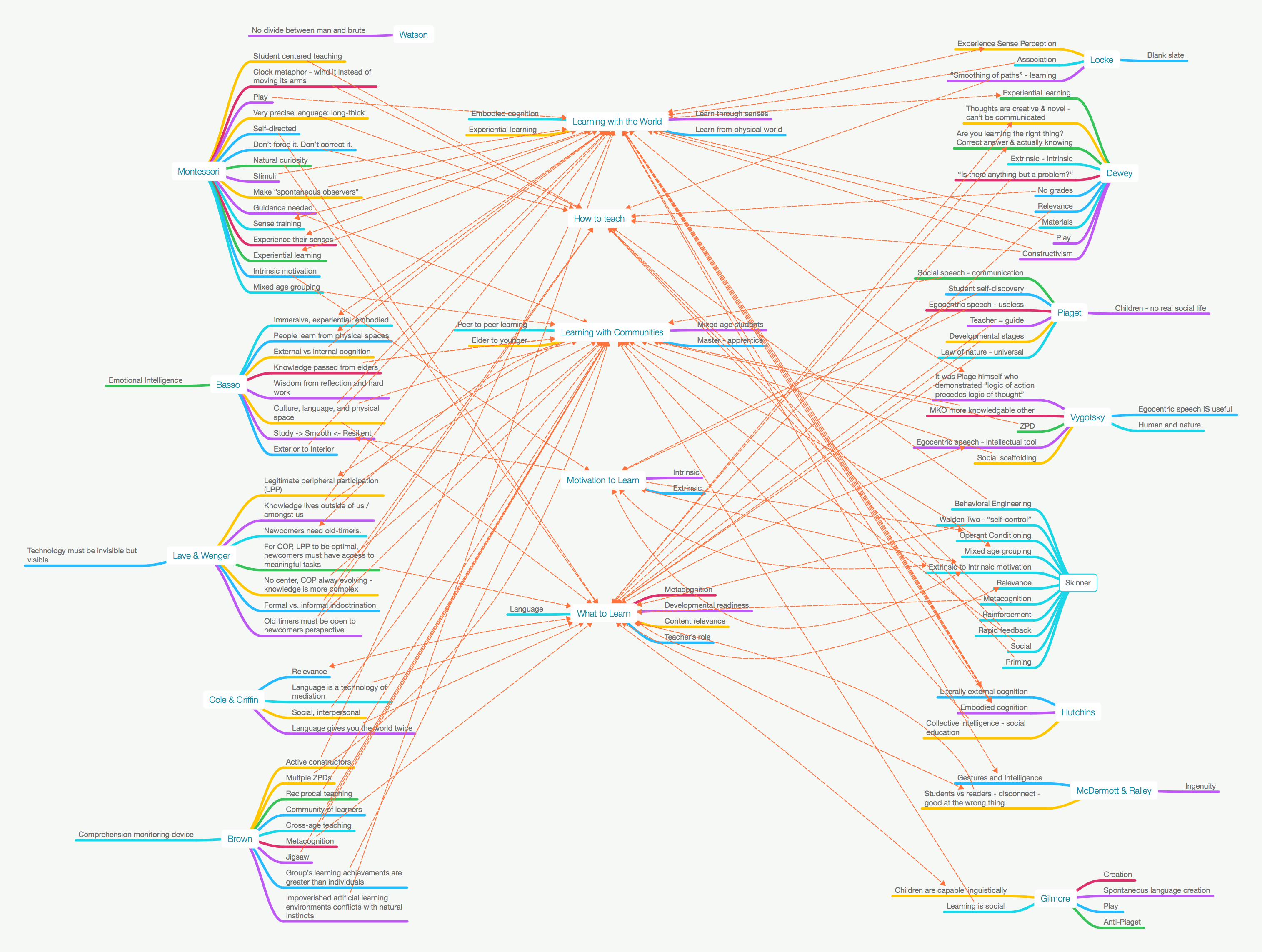
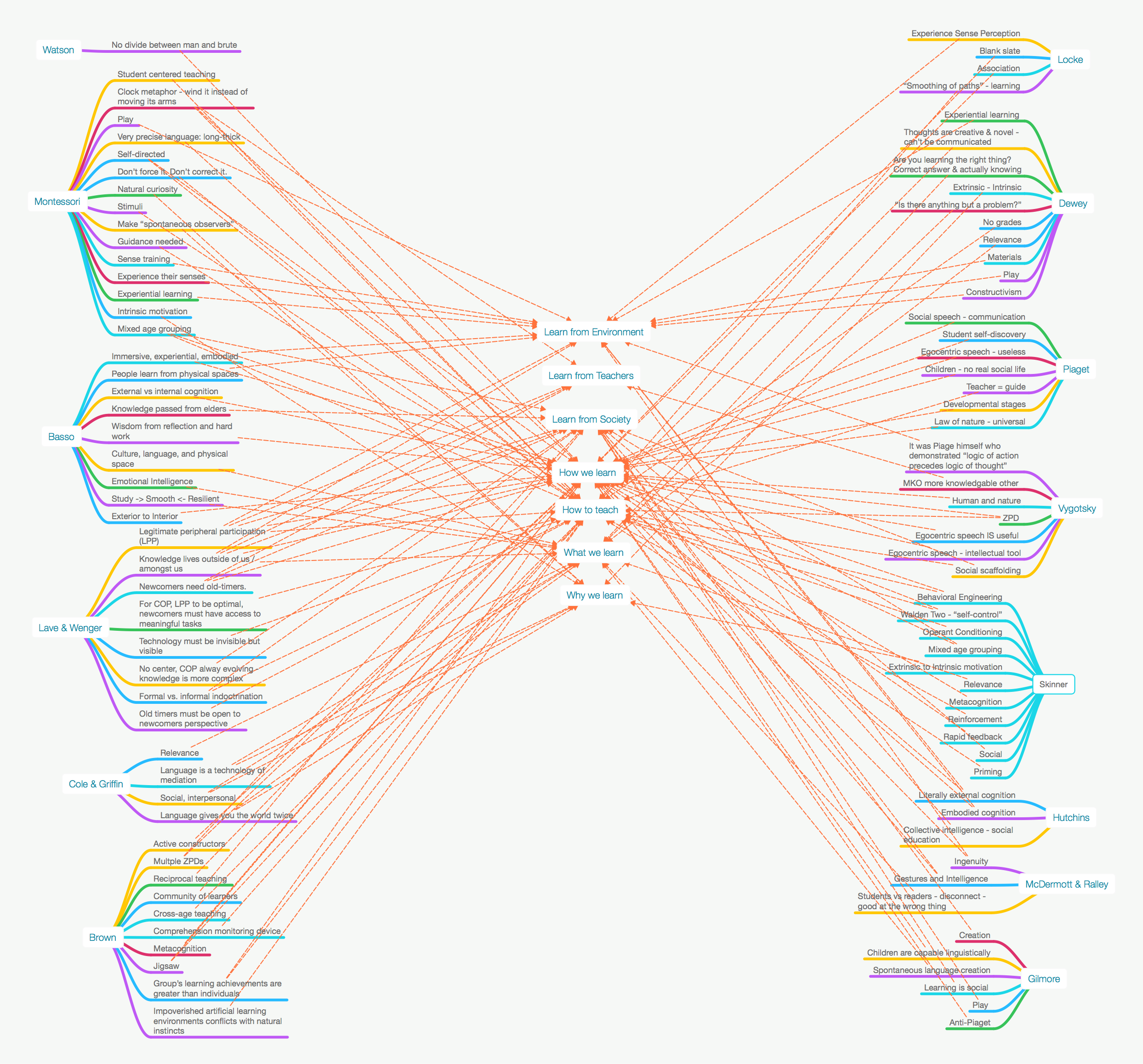
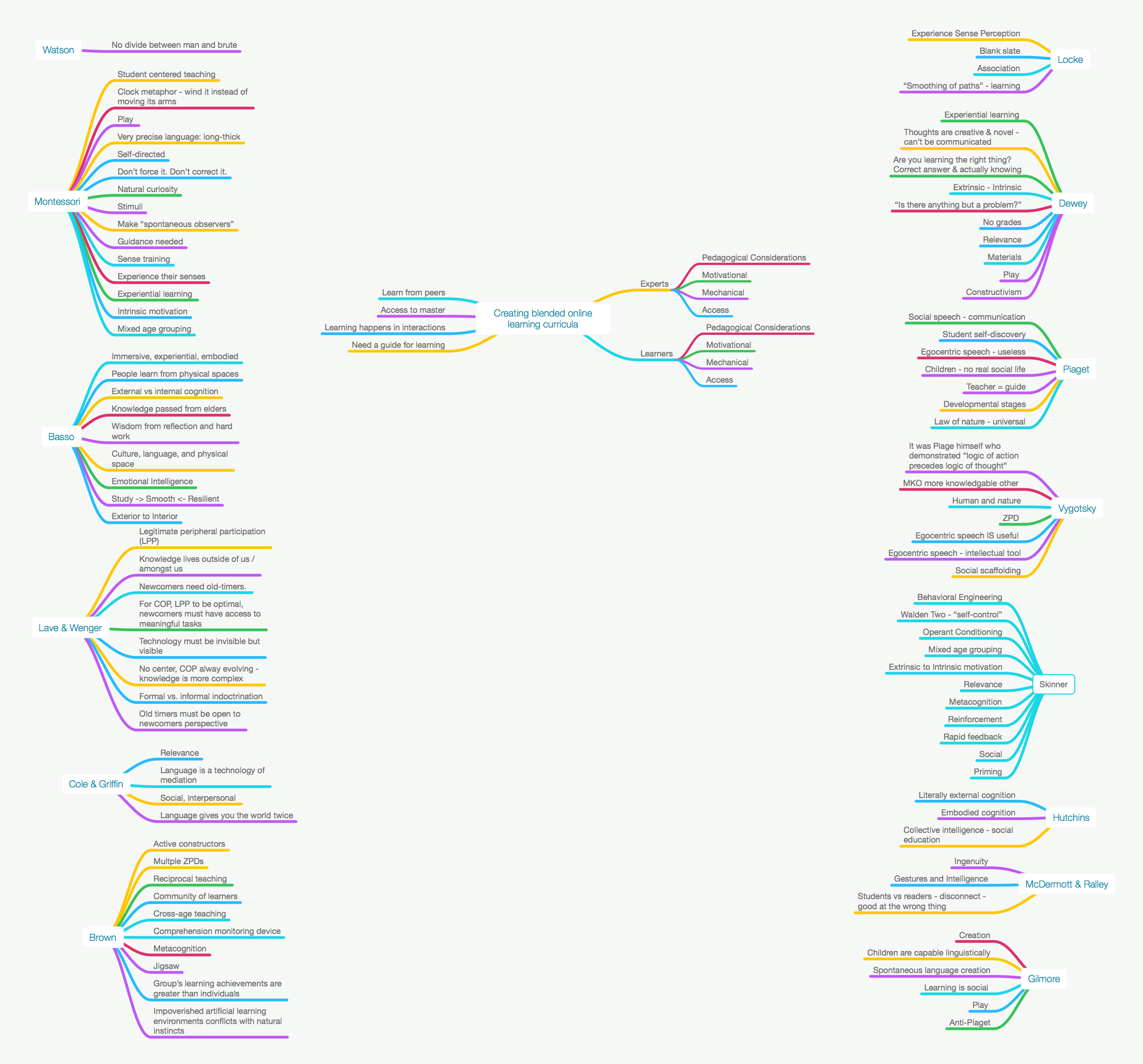
Got all the post its from our group meeting, typed them up and created some mind maps… grouping is coming along but I’m thinking about applying the learning theories to the environment I was observing previously.
Watson
No divide between man and brute
Locke
Experience Sense Perception Blank slate Association “Smoothing of paths” - learning Learning with the World Embodied cognition Learn through senses Experiential learning
Montessori
Student centered teaching Clock metaphor - wind it instead of moving its arms Play Very precise language: long-thick Self-directed Don’t force it. Don’t correct it. Natural curiosity Stimuli Make “spontaneous observers” Guidance needed Sense training Experience their senses Experiential learning Intrinsic motivation Mixed age grouping
Dewey
Experiential learning Thoughts are creative & novel - can’t be communicated Are you learning the right thing? Correct answer & actually knowing Extrinsic - Intrinsic “Is there anything but a problem?” No grades Relevance Materials Play Constructivism
Piaget
Social speech - communication Student self-discovery Egocentric speech - useless Children - no real social life Teacher = guide Developmental stages Law of nature - universal Peer to peer learning Mixed age students Elder to younger Master - apprentice
Basso
Immersive, experiential, embodied People learn from physical spaces External vs internal cognition Knowledge passed from elders Emotional Intelligence Wisdom from reflection and hard work Culture, language, and physical space Study -> Smooth <- Resilient Exterior to Interior
Vygotsky
It was Piage himself who demonstrated “logic of action precedes logic of thought” Egocentric speech IS useful MKO more knowledgable other Human and nature ZPD Egocentric speech - intellectual tool Social scaffolding Motivation to Learn Intrinsic Extrinsic
Lave & Wenger
Legitimate peripheral participation (LPP) Knowledge lives outside of us / amongst us Newcomers need old-timers. For COP, LPP to be optimal, newcomers must have access to meaningful tasks Technology must be invisible but visible No center, COP alway evolving - knowledge is more complex Formal vs. informal indoctrination Old timers must be open to newcomers perspective
Skinner
Behavioral Engineering Walden Two - “self-control” Operant Conditioning Mixed age grouping Extrinsic to Intrinsic motivation Relevance Metacognition Reinforcement Rapid feedback Social Priming Metacognition Developmental readiness Language Content relevance Teacher’s role
Cole & Griffin
Relevance Language is a technology of mediation Social, interpersonal Language gives you the world twice
Hutchins
Literally external cognition Embodied cognition Collective intelligence - social education McDermott & Ralley
Gestures and Intelligence
Ingenuity Students vs readers - disconnect - good at the wrong thing
Brown
Active constructors Multple ZPDs Reciprocal teaching Community of learners Cross-age teaching Comprehension monitoring device Metacognition Jigsaw Group’s learning achievements are greater than individuals Impoverished artificial learning environments conflicts with natural instincts
Gilmore
Creation Children are capable linguistically Spontaneous language creation Learning is social Play Anti-Piaget