Hunicke, R., LeBlanc, M., & Zubek, R. (2004, July). MDA: A formal approach to game design and game research. In Proceedings of the AAAI Workshop on Challenges in Game AI (Vol. 4, p. 1).
- Mechanics, Dynamics, and Aesthetics (MDA) Framework
- Formal approach to understanding games
- Facilitate the conversation between developers, scholars, and researchers.
- Bridge the gap between game design and development, game criticism, and technical game research
- Components:
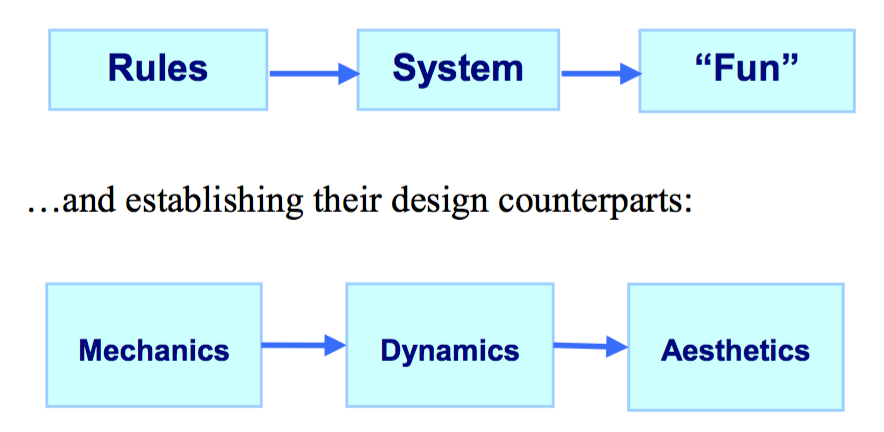
- Mechanics describes the particular components of the game, at the level of data representation and algorithms.
- Dynamics describes the run-time behavior of the mechanics acting on player inputs and each others’ outputs over time.
- Aesthetics describes the desirable emotional responses evoked in the player, when she interacts with the game system.
- Games
- More like artifacts than media
- Purchased, used, and then cast away – consumable product
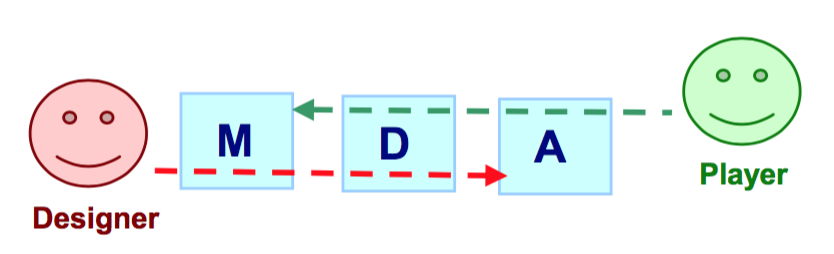
- “From the designer’s perspective, the mechanics give rise to dynamic system behavior, which in turn leads to particular aesthetic experiences. From the player’s perspective, aesthetics set the tone, which is born out in observable dynamics and eventually, operable mechanics.” (Hunicke, LeBlanc, & Zubek, 2004, p.2)
- Aesthetic Models
- Sensation: Game as sense-pleasure
- Fantasy: Game as make-believe
- Narrative: Game as drama
- Challenge: Game as obstacle course
- Fellowship: Game as social framework
- Discovery: Game as uncharted territory
- Expression: Game as self-discovery
- Submission: Game as pastime
Schell, J. (2014). The Art of Game Design: A book of lenses. CRC Press.
(Read Chapter 8 Psychographics section & Chapter 10: Mechanics 1-5)
Chapter 8 – Psycographics
- Demographics : Psychographics
- LeBlanc’s Taxonomy of Game Pleasures
- Sensation: using your senses
- Fantasy: using your imagination
- Narrative: sequence of events
- Challenge: problema to be solved
- Fellowship: social
- Discovery: pleasure of new things
- Expression: expresse your self / customize characters
- Submission: leave one world, go to another, submit to its rules
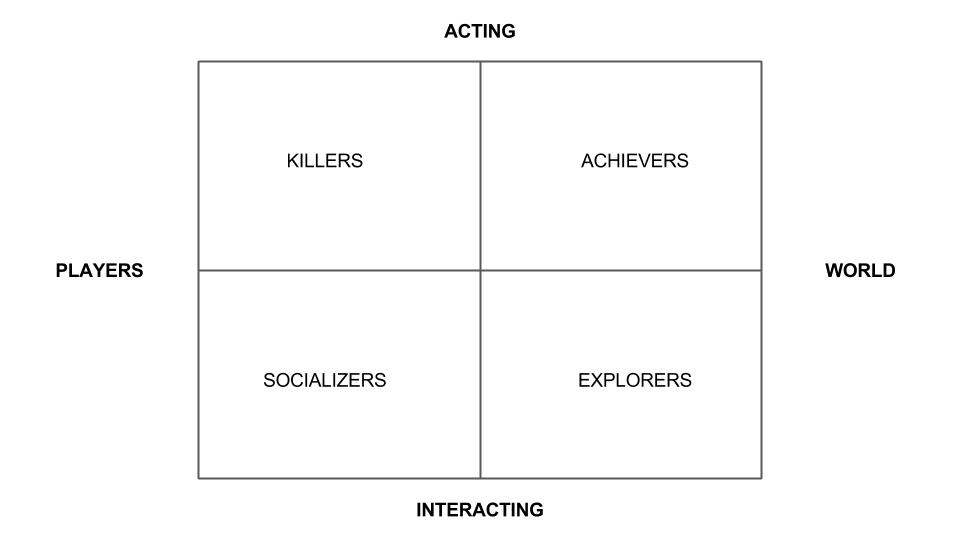
- Bartle’s Taxonomy of Player Types
- ♦ Achievers -> Challenge.
- ♠ Explorers -> Discovery.
- ♥ Socializers -> Fellowship.
- ♣ Killers -> not well mapped… competing, defeating others, imposing themselves on others, helping others
- Not all inclusive: “destruction” and “nurturing” not well mapped for example
- Pleasures to be considered
- Anticipation
- Delight in another’s misfortune
- Gift Giving
- Humor
- Possibility
- Pride in Accomplishment
- Purification
- Surprise
- Thrill
- Triumph over Adversity
- Wonder
- and the list goes on…
- Lens #17: The Lens of Pleasure
- Questions to ask yourself:
- What pleasures does your game give to players? Can these be improved?
- What pleasures are missing from your experience? Why? Can they be added
- Ultimately, the job of a game is to give pleasure.
- Questions to ask yourself:
Chapter 10
- Mechanic 1: Space
- Game spaces
- Are either discrete or continuous
- Have some number of dimensions
- Have bounded areas which may or may not be connected
- Examples
- Tic-tac-toe
- Connected areas
- Nested spaces (Indoor / Outdoor)
- Zero dimensions (question/answer games)
- Lens #21: The Lens of Functional Space
- Space with no surface elements
- Questions:
- Is the space of this game discrete or continuous?
- How many dimensions does it have?
- What are the boundaries of the space?
- Are there sub-spaces? How are they connected?
- Is there more than one useful way to abstractly model the space of this game?
- Game spaces
- Mechanic 2: Objects, Attributes, and States
- State machine
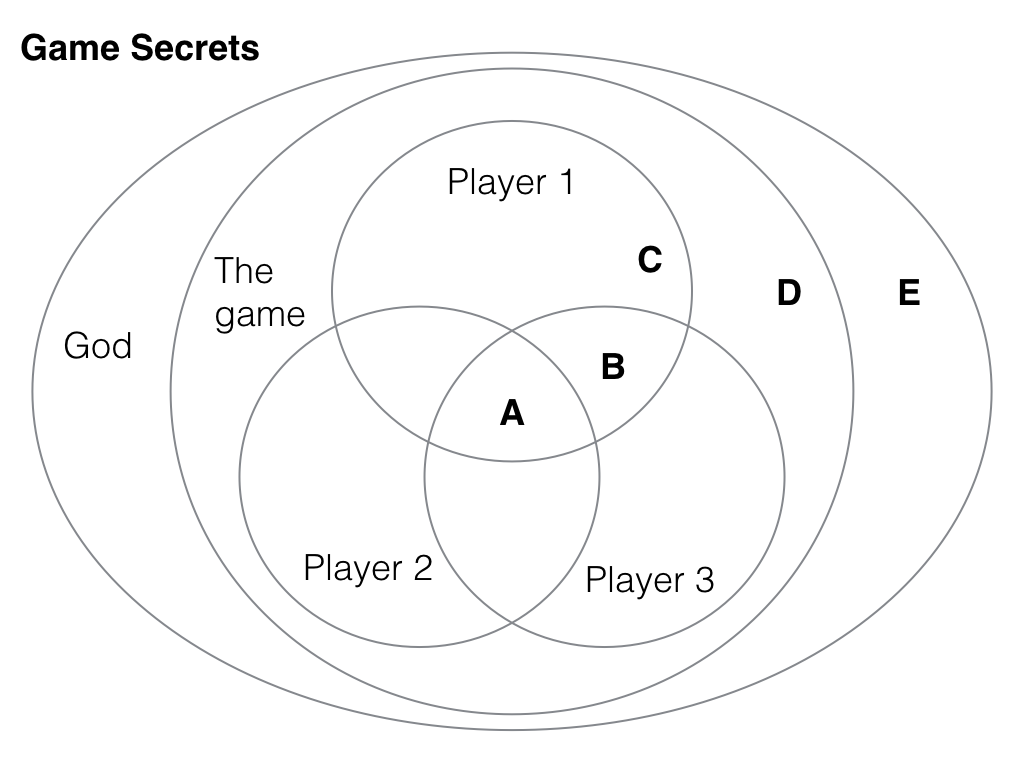
- Secrets
- A: completely public
- B: 2 & 3 know, 1 does not
- C: only 1 knows
- D: games knows, not players
- E: randomly generated information (Fates, God, etc.)
- Lens #22: The Lens of Dynamic State
- What information changes during game and who is aware of it
- Questions:
- What are the objects in my game?
- What are the attributes of the objects?
- What are the possible states for each attribute? What triggers the state changes for each attribute?
- What state is known by the game only?
- What state is known by all players?
- What state is known by some, or only one player?
- Would changing who knows what state improve my game in some way?
- Mechanic 3: Actions
- Operative actions: move checkers forward
- Resultant actions: protect another checker
- Very strategic
- Not part of the rules per se
-
“Most game designers agree that interesting emergent actions are the hallmark of a good game.”
- Planting seeds of emergence
- Add more verbs: related operative actions, but don’t overwhelm user
- Verbs that can act on many objects: shot not only enemie, but other things
- Goals that can be achieved more than one way
- Many subjects: not only one chekcers, many
- Side effects that change constraints: checker’s move changes gamespace
- Lens #23: The Lens of Emergence
- Questions:
- How many verbs do my players have?
- How many objects can each verb act on?
- How many ways can players achieve their goals?
- How many subjects do the players control?
- How do side effects change constraints?
- Stories vs Games
- Endless possibilites vs. limited actions
- Allow for all verbs
- Massively multiplayer games: Second Life
- Questions:
- Lens #24: The Lens of Action
- What players can do, what they can’t, and why.
- Questions:
- What are the operational actions in my game?
- What are the resultant actions?
- What resultant actions would I like to see? How can I change my game in order to make those possible?
- Am I happy with the ratio of resultant to operational actions?
- What actions do players wish they could do in my game that they cannot? Can I somehow enable these, either as operational or resultant actions?
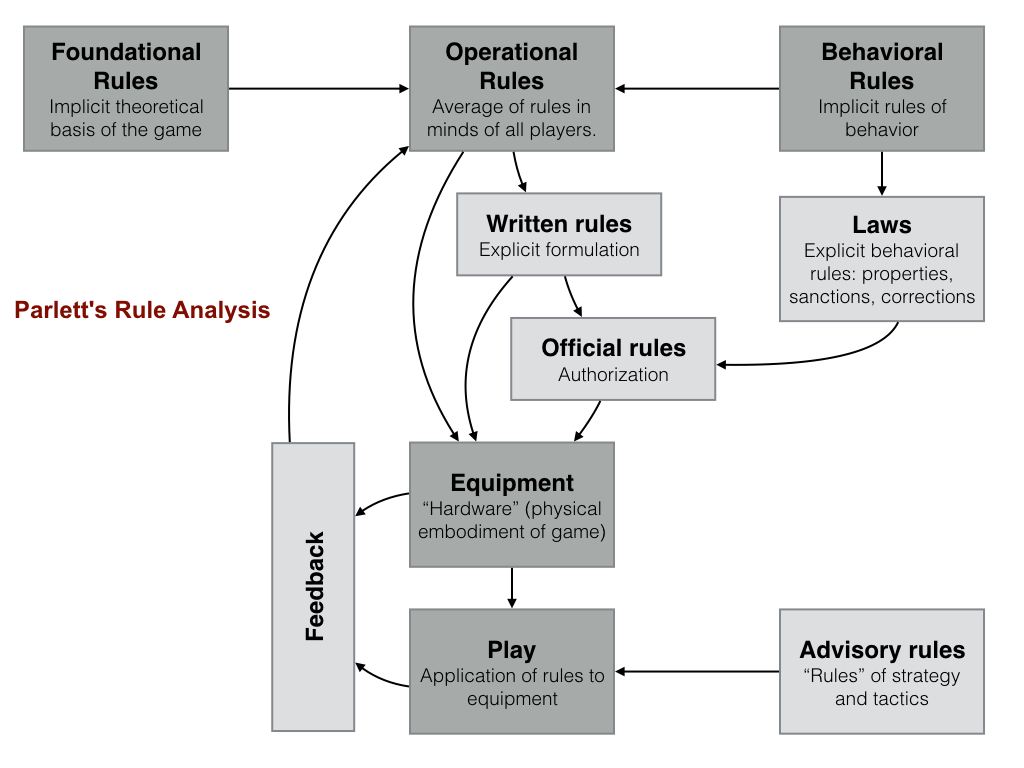
- Mechanic 4: Rules
- Most fundamental mechanic
- Rules:
- Operational: what can you do in the game
- Foundational: inform operational rules
- Behavioral: unwritten rules of good sportsmanship
- Written: no ones reads them -> in-game tutorials
- Laws: tournament rules
- Official: merge written rules with the laws
- Advisory: tips on game mechanics
- House: feedback, adaptation of gameplay to context
- Modes
- Rules change in different modes
- The Enforcers
- Traditional games: players themselves
- Computer games: the game
- The Most Important Rule
- Rule that is at the foundation of all others
- The Object of the Game: explained simply and clearly
- Chess
- “Capture the opponent’s King”
- Good Goals
- Concrete
- Achievable
- Rewarding (look at Lens of Pleasure)
- Lens #25: The Lens of Goals
- Appropriate and well-balanced
- Questions:
- What is the ultimate goal of my game?
- Is that goal clear to players?
- If there is a series of goals, do the players understand that?
- Are the different goals related to each other in a meaningful way?
- Are my goals concrete, achievable, and rewarding?
- Do I have a good balance of short- and long-term goals?
- Do players have a chance to decide on their own goals?
- Lens #26: The Lens of Rules
- Look deep – most basic structure
- Questions:
- What are the foundational rules of my game? How do these differ from the operational rules?
- Are there “laws” or “house rules” that are forming as the game develops? Should these be incorporated into my game directly?
- Are there different modes in my game? Do these modes make things simpler, or more complex? Would the game be better with fewer modes? More modes?
- Who enforces the rules?
- Are the rules easy to understand, or is there confusion about them? If there is confusion, should I fix it by changing the rules or by explaining them more clearly?
- Game design/invention process
- Operational rules
- Foundational rules
- Written rules (end)
- Mechanic 5: Skill
- Skills
- Physical Skills
- Mental Skills
- Social Skills
- Real vs. Virtual
- Player vs. Character
- Enumerating Skills
- Lens #27: The Lens of Skill
- Look at the skills asked of players.
- Questions:
- What skills does my game require from the player?
- Are there categories of skill that this game is missing?
- Which skills are dominant?
- Are these skills creating the experience I want?
- Are some players much better at these skills than others? Does this make the game feel unfair?
- Can players improve their skills with practice?
- Does this game demand the right level of skill?
- Skills