- Sleep help us to see or formulate patterns
- Memorization also is helped by time – better to study over 3 days rather than all in one day
Graphs
- Pie charts are hard to show differences in sizes
- Line charts imply that the horizontal axis is a continuum
Graphs
On Sunday drove into the city with Omair to visit the Drop-In Art Studio’s Maker Art and Mini Expo featuring Stanford’s LDT student projects. Unfortunately we got there a little late and weren’t able to see much. BUT we went upstairs and saw the NEAT: New Experiments in Art and Technology exhibit. Very ITP-like stuff (interactive/technological art)
Here’s a quick video I made:
This class uses a book written by the Dean of the Graduate School of Education and his 2 research assistants (our teachers for the course)
Daniel L. Schwartz, Jessica M. Tsang, Kristen P. Blair
Pedrosa, R. H., Simões, T. P., Carneiro, A. M., Andrade, C. Y., Sampaio, H., & Knobel, M. (2014). Access to higher education in Brazil. Widening Participation and Lifelong Learning, 16(1), 5-33. Chicago
Article about access and equity in Higher Education in Brazil in the last 20 years.
Colby, A., Ehrlich, T., Sullivan, W. M., & Dolle, J. R. (2011). Rethinking undergraduate business education: Liberal learning for the profession (Vol. 20). John Wiley & Sons.
“What do you think are the most important goals of PD? Why are those goals so important?”
The most important goal of PD is to teach teachers how to think. Think about their teaching, how students learn, what context learning is happening in, and what content is being delivered. As defined by Thompson & Zeuli (1999), thinking relates to “using information and experience” (p.346) to “solve problems, resolve dissonances between the way they initially understand a phenomenon and new evidence that challenges that understanding” (p.346). In the same way that reformers desire to instill thinking about learning in students, PD must do the same for teachers. “But thinking to learn is different from learning to think, and it is thinking to learn we see as central to reformed practice in science and mathematics” (Thompson & Zeuli, 1999, p.350). Effective PD must create a cultural change in the profession.
Thinking about how they teach involves provoking a deep change in how teachers believe their in and out of class activities should look like. “This kind of teaching and learning would require that teachers become serious learners in and around their practice, rather than amassing strategies and activities.” (Ball, D., & Cohen, D., 1999, p.4). As exemplified by Cohen with Mrs. Oublier’s case, more often than not, teachers will pick and choose small parts of what they learn in PD and adapt them to their traditional teaching style instead of rethinking the style itself. Yet habits die hard, thereby the need to have prolonged and sustained PD throughout the year in order to be constantly observing, learning and adjusting one’s teaching. “Professional development could be substantially improved if we could develop ways to learn and teach about practice in practice” (Ball, D., & Cohen, D., 1999, p.12).
How students learn is another facet of what PD must teach teachers to think about. Many teachers might still have the mind set of “teaching as telling and learning as remembering” (Thompson & Zeuli, 1999, p.349). This is an outdated vision that has been widely disproven by research.
“Students do not get knowledge from teachers, or books, or experience with hands-on materials. They make it by thinking, using information and experience. No thinking, no learning – at least, no conceptual learning of the kind reformers envision.”, (Thompson, C. L., & Zeuli, J. S. 1999, p.346)
The challenge here is how to teach this through PD, making teachers think about their students in a ‘novel’ way.
“The key questions for reform, then, are whether teachers understand that students must think in order to learn and whether they know how to provoke, stimulate, and support students’ thinking.” (Thompson, C. L., & Zeuli, J. S. 1999, p.349)
Not only must teachers must drive student’s thinking, they must constantly observe the progression of the classroom and adapt in real time. They must think on their feet to find better analogies, explanations or activities that support the student in learning. Therefore PD must also teach formative assessment strategies and metacognitive skills to constantly analyze their practice. This includes recording their own teaching, observe others teaching, look closely at student’s work and what responses they give in class. “Teachers would need to learn how to use what they learn about student’ work and ideas to inform and improve teaching”, (Ball, D., & Cohen, D., 1999, p.11)
PD must also have the goal of contextualizing the curriculum and program to the specific scenario it is inserted in. Ideally we would want a generic format for PD, which is foreseeably possible when talking about pedagogy, classroom management and other non-content specific items.
“In other words, the professional development efforts in every one of these investigations centered directly on enhancing teachers’ content knowledge and their pedagogic content knowledge (Shulman 1986). The activities were designed to help teachers better understand both what they teach and how students acquire specific content knowledge and skill.”, Guskey, T. R., & Yoon, K. S., 2009, p.497)
Yet research also shows that PD must be tailored for the specific content to the teacher’s area and be aligned with the teacher’s reality. Specific content aids teachers transfer the knowledge being presented during the sessions into their practice.
“This corroborates the position taken by the National Staff Development Council (2001), which argues that the most effective professional development comes not from the implementation of a particular set of “best practices,” but from the careful adaptation of varied practices to specific content, process, and context elements.”, (Guskey, T. R., & Yoon, K. S., 2009, p.497)
Not only the content must be tailored to the subject matter, but the context must be taken into consideration. Social, economic, and cultural factors certainly influence teachers’ perceptions of what teaching looks like and what is required to be able to connect and engage with students.
Another major goal of PD must be to offer continued and prolonged support for teachers. Research shows that communities of practice help teachers feed off of each other, learn from each other and support each other in further developing their skills.
“Continuing thoughtful discussion among learners and teachers is an essential element of any serious education, because it is the chief vehicle for analyst, criticism, and communication of idea, practices, and values.” (Ball, D., & Cohen, D., 1999, p.13)
These communities though, must be accompanied by the PD program to ensure that the interactions are fruitful and do not fall back into the status-quo and become a forum for lamenting the ails of the job.
“Guberman (1995) has noted how easily collegially oriented efforts can create a ‘discussion culture’ unhinged from actual changes in classroom practice. ‘Inquiry groups’ in name can turn out to be emotional support groups in practice, valuable to the morale and mental health of participants but unlikely to effect real changes in their beliefs or knowledge.” (Thompson & Zeuli, 1999, p.353)
In part I believe, this is a reason why PD programs must offer continuous support for the teachers – to disentangle old notions and aid teachers in transforming their current practice.
In conclusion, I see the challenges of PD as not very different from the challenges in education. Once it is acknowledged that teachers are students with respect to the research available in PCK, cognition, and relevant content; PD might be transformed and become more effective as well. Therefore, the main goal of PD is the same as the goals for education: student achievement gains – one of the most complex problems humanity faces nowadays, in my opinion – and the reason why PD is so important and should be given attention as the main carrier of transformation.
“Ironically, while the role of the teacher educator is critical to any effort to change the landscape of professional development, it is a role for which few people have any preparation and in which there are few opportunities for continued learning: the is little professional development for professional developers.” (Ball, D., & Cohen, D., 1999, p. 28)
References
Ball, D., & Cohen, D. (1999). Toward a practice-based theory of professional education. Teaching as the Learning Profession San Francisco: Jossey-Bass.
Guskey, T. R., & Yoon, K. S. (2009). What works in professional development. Phi delta kappan,90(7), 495-500.
Thompson, C. L., & Zeuli, J. S. (1999). The frame and the tapestry: Standards-based reform and professional development. Teaching as the learning profession: Handbook of policy and practice, 341-375.
van Driel, J. H., Meirink, J. A., Van Veen, K., & Zwart, R. C. (2012). Current trends and missing links in studies on teacher professional development in science education: a review of design features and quality of research. Studies in science education, 48(2), 129-160.
Awesome! Solid fitting of the box, no extra noise and a enough power. Fast as well! Have to slow down in turns.
Ball, D., & Cohen, D. (1999). Toward a practice-based theory of professional education. Teaching as the Learning Profession San Francisco: Jossey-Bass.
van Driel, J. H., Meirink, J. A., Van Veen, K., & Zwart, R. C. (2012). Current trends and missing links in studies on teacher professional development in science education: a review of design features and quality of research. Studies in science education, 48(2), 129-160.
“They consider new teaching practices as practical when (a) efficient procedures are available to translate innovative ideals into concrete instruction; (b) the change in proposal fits their current practice and goals sufficiently; and (c) implementation of the innovation will require limited investment, whereas the expected benefits are substantial (Doyle & Ponder, 1977).“, p.130
Core design features of PD programs:
Features of Research Quality
Organizing Frame
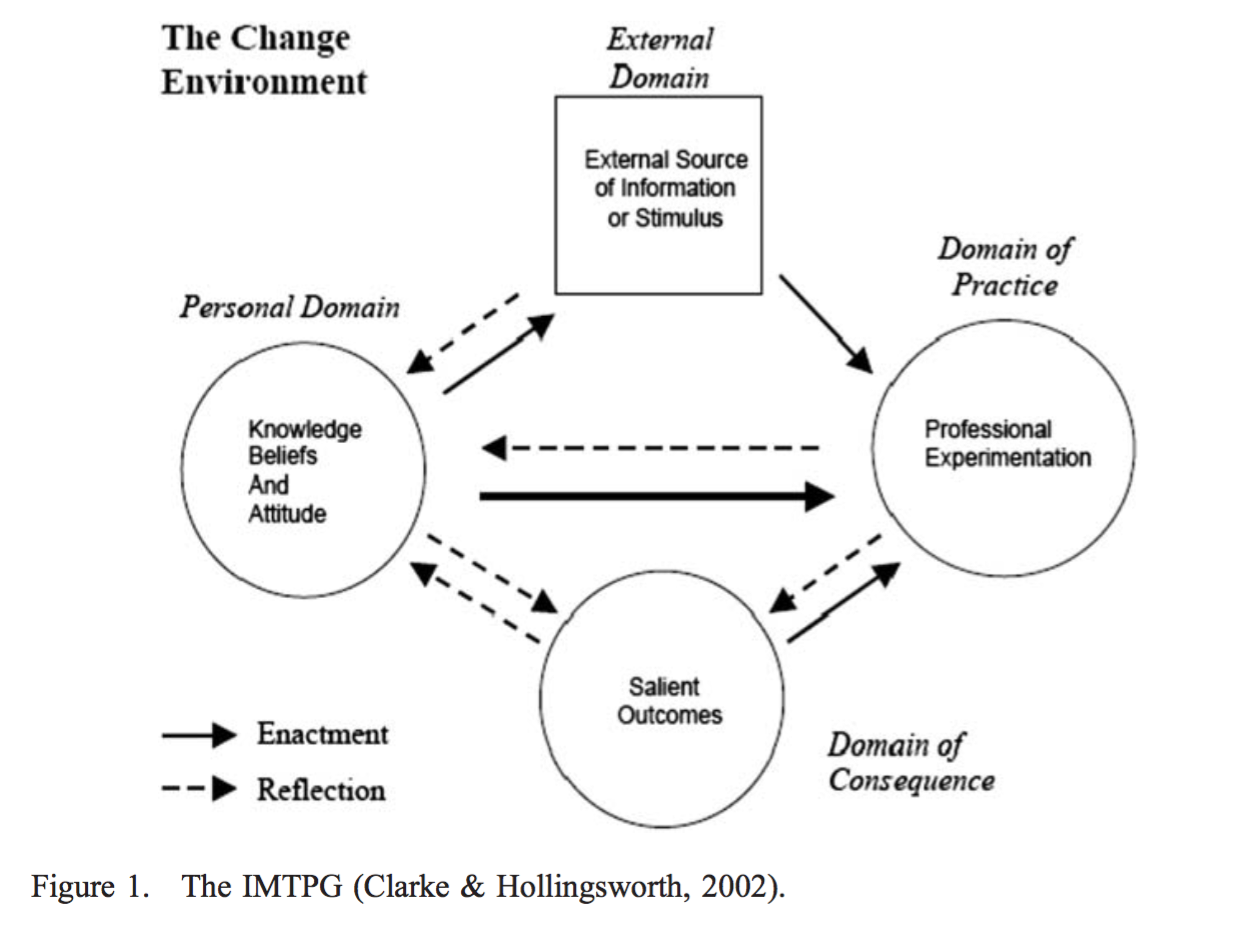
Guskey, T. R., & Yoon, K. S. (2009). What works in professional development. Phi delta kappan,90(7), 495-500.
“A research synthesis confirms the difficulty of translating professional development into student achievement gains despite the intuitive and logical connection.”, p.495
“One of the most discouraging findings in the project was the discovery that only nine of the original list of 1,343 studies met the standards of credible evidence set by the What Works Clearinghouse, the arm of the U.S. Department of Education that is charged with providing educators, policy makers, researchers, and the public with scientific evidence about “what works” in education.”, p.496
Workshops
Outside Experts
Time
Follow-up
Activities
Content
Implications
Thompson, C. L., & Zeuli, J. S. (1999). The frame and the tapestry: Standards-based reform and professional development. Teaching as the learning profession: Handbook of policy and practice, 341-375.
As part of receiving the generous fellowship, we are encouraged to write a thank you letter to our sponsors… here’s mine:
Dear Mr. Lemann,
I am a Masters candidate at the Learning, Design, and Technology (LDT) program at Stanford, writing to you to express my gratitude for your generous contribution towards my studies. It is an honor to be recognized by Stanford and the Lemann Fellowship and be part of such a great initiative to help Brazilian public education.
My Stanford experience so far has exceeded all of my expectations. I did not know it was possible to learn so much in such a little time. I did not expect the classes to be so rich, interactive and collaborative as they are. I am continuously amazed to see what we are learning about education being applied to ourselves during the classroom activities. I am in awe of the stellar level of the professors, leaders in their fields and mentioned continuously throughout the research papers that we read.
I started a small school that teaches mobile app development in São Paulo 6 years ago. The more I learn here, the more I know how much I can improve my school in terms of curriculum, teacher’s effectiveness, promotion of knowledge, assessment, and student motivation. I already know that I will be able to apply the knowledge being acquired here onto my school. Yet more importantly, I am seeing how complex education is. It is probably the most complex problem humanity faces nowadays. I believe it is far easier to colonize Mars than to educate the world effectively. To start off with, we need educated engineers and scientists to be able to go to Mars – therefore, education is the basis of our civilization.
My focus here will be on teacher professional development (PD). I believe it is the first step towards educational reform. Without better PD, it is impossible to change the system since teachers are the catalyst of this transformation. Online learning promises education at scale but it has been proven that it alone is not sufficient. Humans learn better from humans. We need coaches, facilitators, guides, and motivators to keep us on track, on point, and continuously moving forward in our learning progression. Teachers need to understand how to promote a growth mindset in students, how to explain the content appropriately, and to assess student learning in realtime.
For opening my eyes, I thank you. For creating the Lemann Fellowship, I salute you. For persevering with your business in Brazil and around the world, I admire you. If only we had more politicians, leaders, and agents with you vision in Brazil…
Sincerely,
Lucas Longo
Professor:
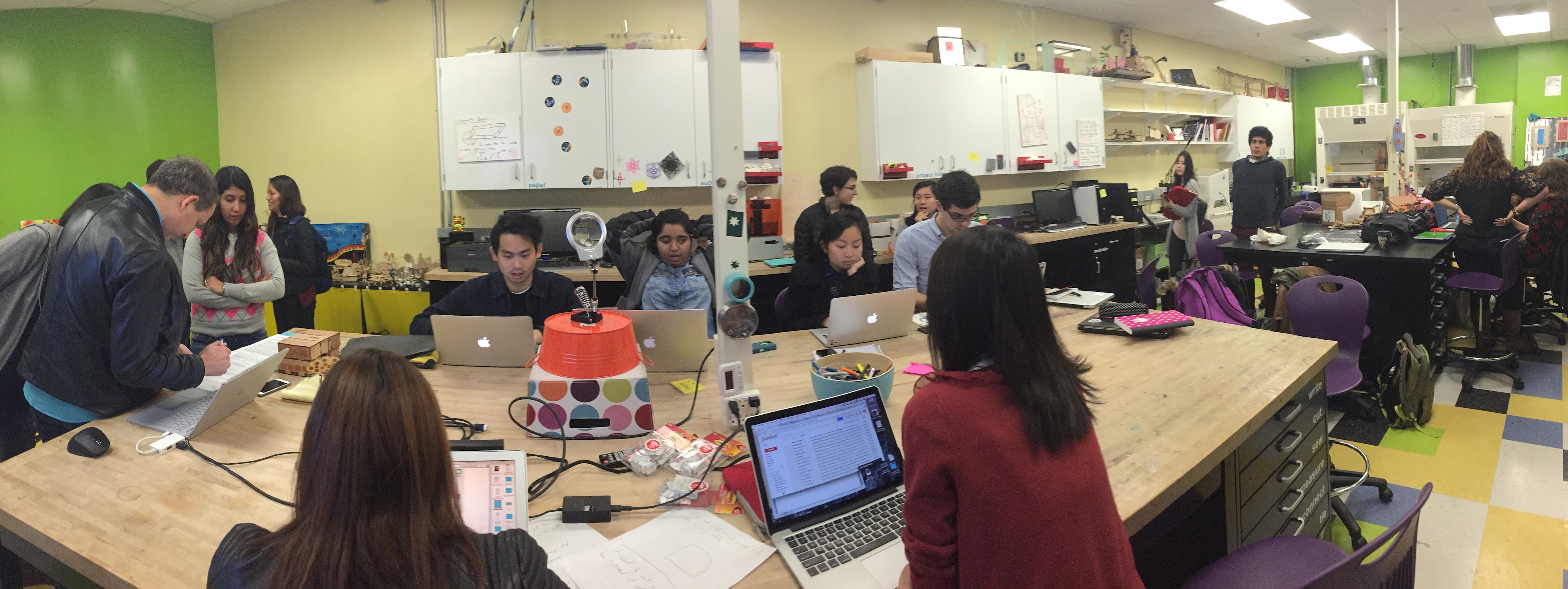
In class exercise:
My Learning and Teaching Story
When I was a kid a was fortunate enough to have many Lego kits and a father who is an architect. I was always fascinated at how he was able to think of a space in his head, draw it on paper, and the build it. Legos offered me that experience – especially when I moved to their Technique series. I was never interested in playing with Lego as a storytelling arena or a fantasy world environment. I was interested in building the models offered in the instructions in able to learn what specialty pieces I had and then repurpose them into new formats and functions. This thought me enormously about spatial thinking, mechanics, gears, electric motors, and reverse engineering. I clearly remember my mother going nut when I disassembled the TV set just to look at how it was built inside. Without my experience with Legos, I am sure I would never have been able to put the TV back together.
Moving ahead in time, I found myself teaching Lego robotics as an extra curricular activity in high schools. Lego Techniques had advanced into Lego Mindstorm, where you could finally program behavior, use sensors, and outputs. It increased the learning curve for the kids who had to first learn about structure, reinforcement, and forces that acted upon what they were building. Then they had to understand about inputs, outputs, thresholds, activation and deactivation. Finally they had to put it all together into a ‘robot’ and program its behavior. What I learned from this experience was that teaching is the best way to learn. I quickly realized this and suggested to the kids who were further along or finished their own project, to help their neighbor. The class came alive and the projects rapidly moved from frustrations to energetic show and tell.
Notes:
Equity – it is not only about making materials available, it is also about training the teachers well, and most importantly, promote a growth mindset on the students.
Example of 2 day cares in Brazil – both rated equally, funded equally, and with good teachers. The difference was in the socio-economic level of the students. The higher income students were more demanding of the teachers. Lower income students would remain quiet and felt it was not their place to demand for attention or to say that they did not know how to do something.
In class Reading:
Papert, S., & Solomon, C. (1971). “Twenty things to do with a computer.”
“Only inertia and prejudice, not economics or the lack of good educational ideas, stand in the way of providing every child in the wolrd with the kind of expereince of which we have tried to give you some glimpses”, p.40
My ‘new’ ideas:
Discussion:
Should everyone learn how to code or should everyone learn how to use the computer?
Does a product’s ubiquity be a necessity for people to learn what is going on ‘under-the-hood’?
At the time of the paper, there was no internet and the integration of these simulations with learning goals were not explicitly stated.
At the time – the challenge was to teach the teachers on how to use this technology within their curriculum. The eternal problem of Teacher PD (Professional Development).
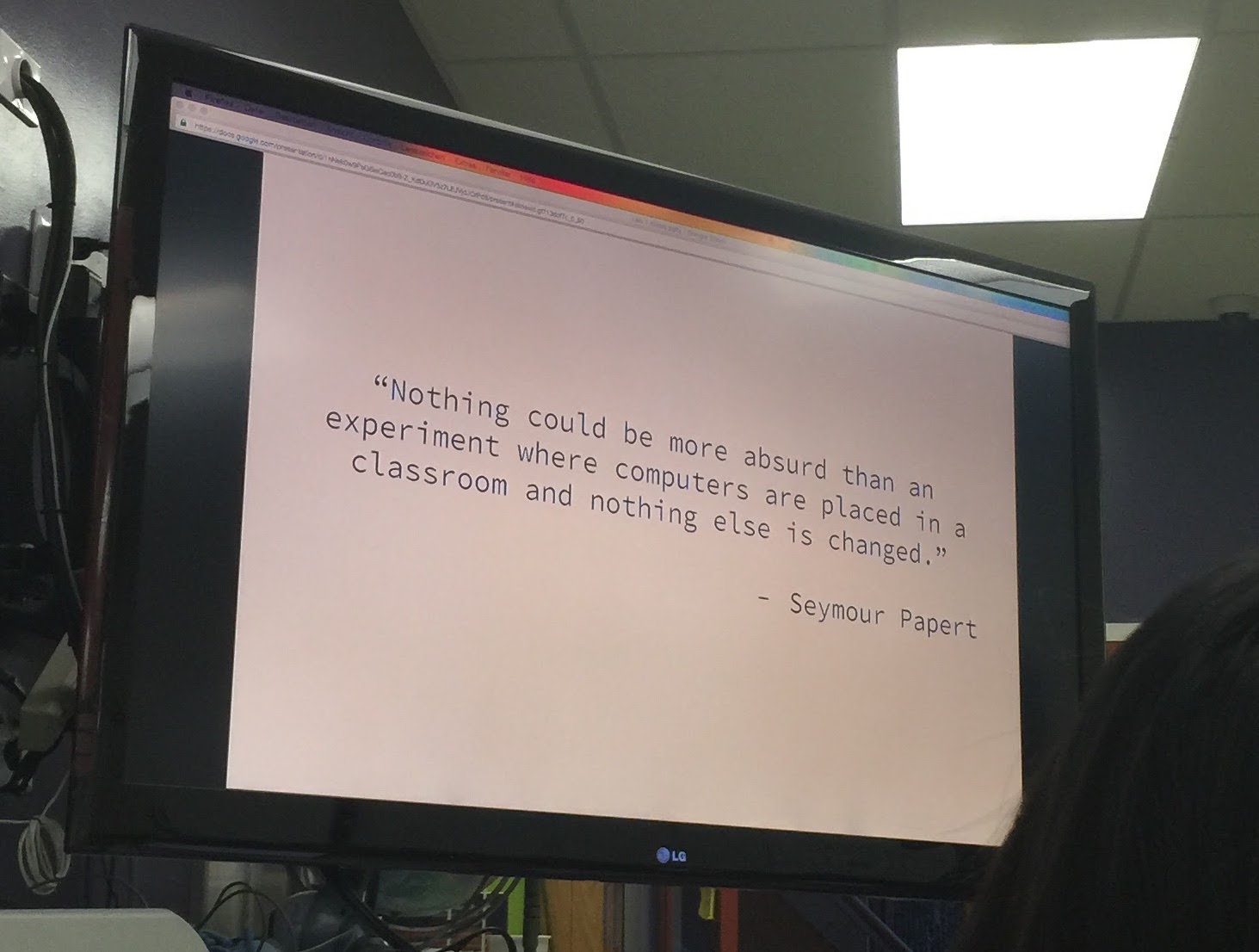
“Nothing could be more absurd than an experiment where computers are placed in a classroom and nothing else changed.” – Seymour Papert
Painting elephants: guided by their trainer through the elephant’s ear they produce great paintings. But this is similar to our educational system… the students produce results but are they really aware of what they are making?

Categories of technology
This is going to be a fun class 🙂
Post-It activity: What are learning technologies? How would you categorize them?
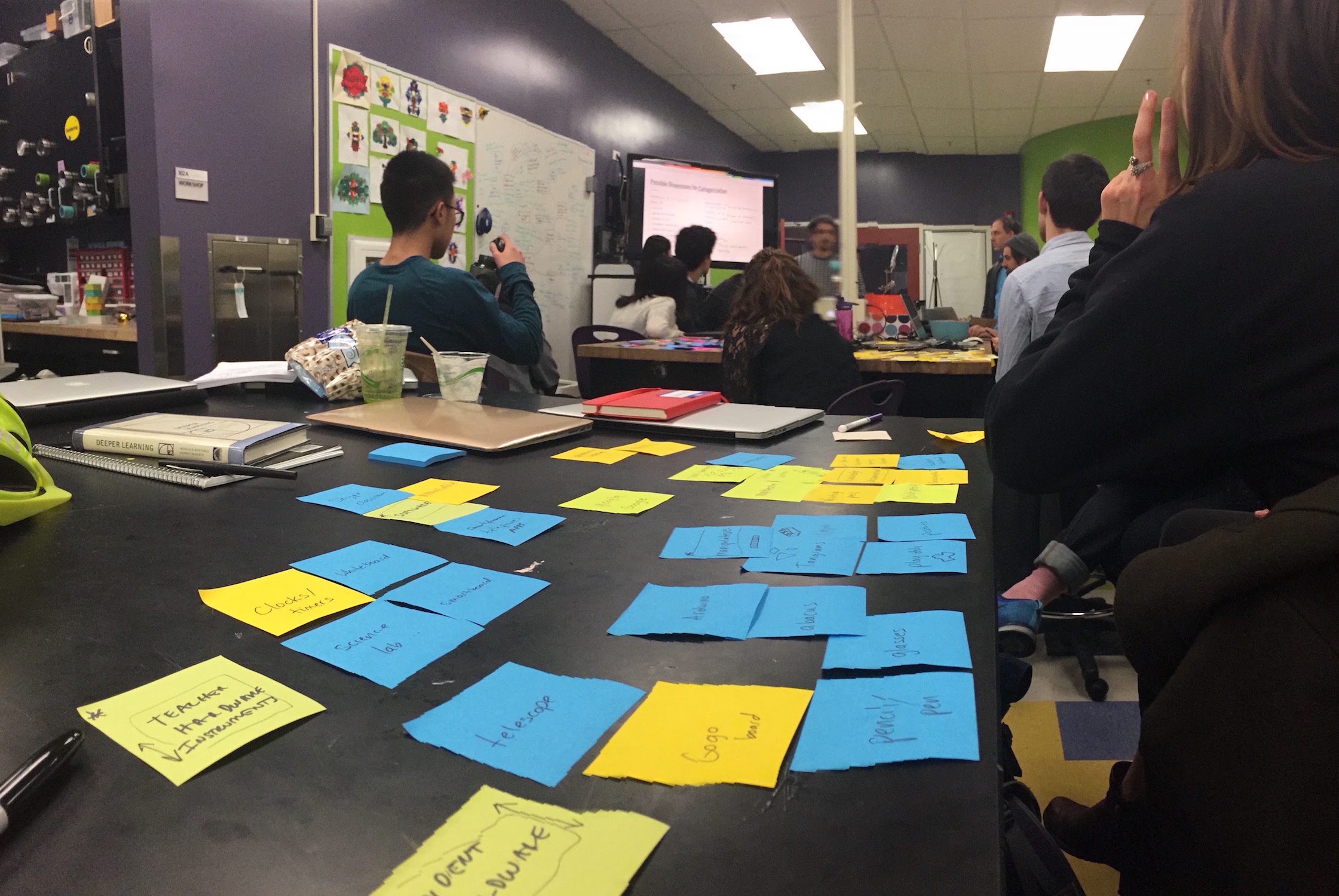
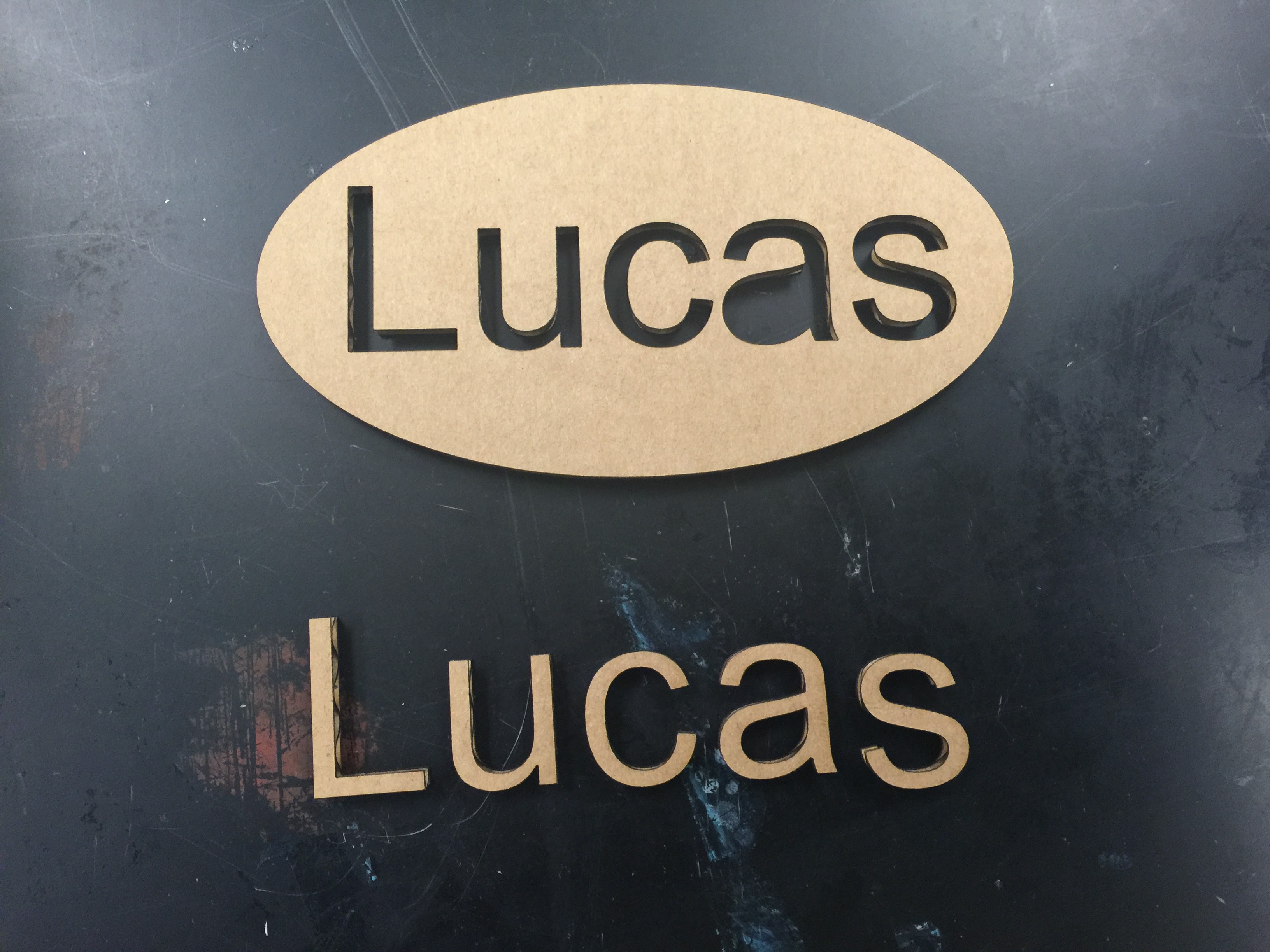
Fabrication Lab – looked at laser cutter and rapid prototyping techniques with cardboard, foam core, hot glue and tape.
Reading
Brown, A. L., & Kane, M. J. (1988). Preschool children can learn to transfer: Learning to learn and learning from example. Cognitive Psychology,20(4), 493-523.
Summary
Studies on how learning can happen through only one or few examples, both for children and machine learning. Explaining the one example leads to greater transfer, vs just looking at the example. Learn by teaching.
“In this series of studies we examined whether young children can abstract a general rule from examples and, if so, whether their learning is influenced by their ability to explain why the concept is an instance of the rule.”
Mental Notes
Citations
“Transfer is not automatic but depends upon insight into general principles.”, p.495
“Telling children that problems are the same, without specifying how, is one of the methods that has promoted successful transfer in young children (CrisatI, 1986; Crisafi & Brown, 1986). Therefore, this obvious mention of the common action and of problem similarity should promote transfer if anything would; thus, the hint condition was regarded as a yardstick against which the other manipulations could be measured.”, p.500
“This means that the 3-year-olds show a reliable learning to learn effect only if they are encouraged to reflect on their solutions, either through discussions, instructing Kermit, or explicit prompts to problem similarity.”, p. 501
“Taken together the results of Studies 4 and 5 suggestthat examples are more useful in promoting transfer than the provision of an explicit statement of the general rule.”, p.512
“Taken together, Studies 5, 6, and 7 demonstrate the efficacy of having learners generate explanations of why an example is an instance of a concept.”, p.516
“Exposing children to a variety of transfer experiences teaches them to search for underlying commonalities.”, p.516
“If children spontaneously recall, or elaborate on why an example is an instance of a deeper relational mechanism, or if they are led to such elaborations by probing questions, they transfer readily. Elaborations and explanations provided by the subjects themselvesare more effective in promoting transfer than those provided by the experimenter, an effect reminiscent of the use of self-produced elaborations in adult learning (Reder et al., 1986).”, p.517
“Efficient learners prepare for transfer by engaging in reasoning processes aimed at elaborating knowledge. With experience, efficient learners develop a mind set to regard new problems, not as isolated examples, but as instances of a general class. Efficient learners come to expect what they learn to be relevant elsewhere. Efftcient learners perform thought experiments in which they actively seek out appropriate analogies. In short, efftcient learners understand some of the principles involved in learning and reasoning; they have a greater metaconceptual grasp of the domain ‘ ‘learning. ’ ’”, p.520